
A tooth extraction Waterdown involves the careful removal of a tooth that cannot be saved due to severe decay, advanced gum disease, or traumatic injury. At Waterdown Smiles Dentistry, we provide a thorough clinical assessment, utilize local numbing to ensure you feel pressure rather than pain, and supply detailed aftercare guidance to promote safe, predictable healing.
Safe and Comfortable Tooth Removal
Protecting your natural teeth is always our primary goal, but there are situations where removing a severely damaged or infected tooth is the best step for your overall health. When you require tooth removal Waterdown, our team at Waterdown Smiles Dentistry focuses on maximizing your comfort and ensuring a smooth recovery. We guide you transparently through the entire tooth extraction procedure, from the initial diagnosis to your final healing stages, ensuring you feel completely supported.
From Diagnosis to Recovery: Here’s What to Expect
-
Careful Assessment: We rely on clinical examinations and digital imaging to determine if a tooth cannot be saved.
-
Pain Management: Local numbing is utilized to minimize discomfort, so most patients feel only pressure, not pain.
-
Clear Expectations: We explain whether a simple or surgical extraction is required before treatment begins.
-
Structured Healing: Initial healing begins within two days, with full healing expected in about two weeks.
What Is a Tooth Extraction?
A dental extraction is a restorative and preventive procedure involving the removal of a tooth that cannot be saved. This procedure is generally performed after a comprehensive Dental Exam confirms that restorative options (like a filling or crown) are no longer viable.
Key aspects of an extraction procedure:
- It prevents infection from spreading to surrounding teeth or bone.
- It prepares the mouth for restorative planning.
- It provides immediate relief from severe, untreatable toothaches.
When Is a Tooth Extraction Necessary?
Patients in Waterdown and Aldershot often seek evaluation for severely decayed teeth, hoping to avoid extraction. However, when intervention is delayed, removal becomes the safest option. Your dentist will evaluate the tooth based on clinical examination and imaging to make the best recommendation.
Common reasons we recommend tooth removal:
-
Severe decay or structural damage that compromises the tooth.
-
Deep dental infections or advanced gum disease requiring Scaling & Root Planing.
-
Orthodontic needs, where crowding requires space.
-
Impacted third molars, which are addressed through Wisdom Tooth Extraction.
-
Acute oral trauma requiring an Emergency Dentist.
Simple vs Surgical Tooth Extraction
Depending on the condition and position of your tooth, we perform either simple or surgical extractions, with the differences explained clearly when relevant.
| Feature | Simple Extraction | Surgical Extraction |
|---|---|---|
| Tooth Status | Visible and fully erupted above the gumline | Broken at the gumline or impacted beneath the bone |
| Technique | Tooth is carefully loosened and removed | A small incision may be needed to access the tooth |
| Procedure Length | Generally a shorter, straightforward procedure | A more complex procedure requiring additional time |
| Healing Expectation | Faster healing with mild soreness | Slightly longer healing; moderate swelling expected |
Is Tooth Extraction Painful?
Fear of pain is the most common reason people delay an emergency tooth extraction. We prioritize your comfort by using local numbing to minimize discomfort.
What you will actually feel:
- Most patients feel pressure, not pain, during the extraction.
- You will be completely numb to sharp sensations.
- If you have high anxiety, we can discuss Dental Sedation options like nitrous oxide to help you relax.
- Patient comfort is continuously monitored throughout the visit.
What Happens During a Tooth Extraction Procedure?
Knowing exactly what to expect helps reduce anxiety. Patients commuting from Hamilton and Flamborough value same-day assessment when available, knowing we will walk them through the entire tooth extraction procedure details before treatment.
The standard steps of a dental extraction:
-
Numbing: Local anesthesia is applied to thoroughly numb the area.
-
Loosening: The tooth is carefully loosened using specialized instruments.
-
Removal: The dentist gently removes the tooth from its socket.
-
Clotting: Gauze is placed over the site to encourage a healthy blood clot.
-
Guidance: Detailed pain management and aftercare instructions are provided.
Tooth Extraction Healing Time – What to Expect
Understanding the tooth extraction healing time ensures you do not panic over normal physiological responses.
The standard tooth extraction healing stages:
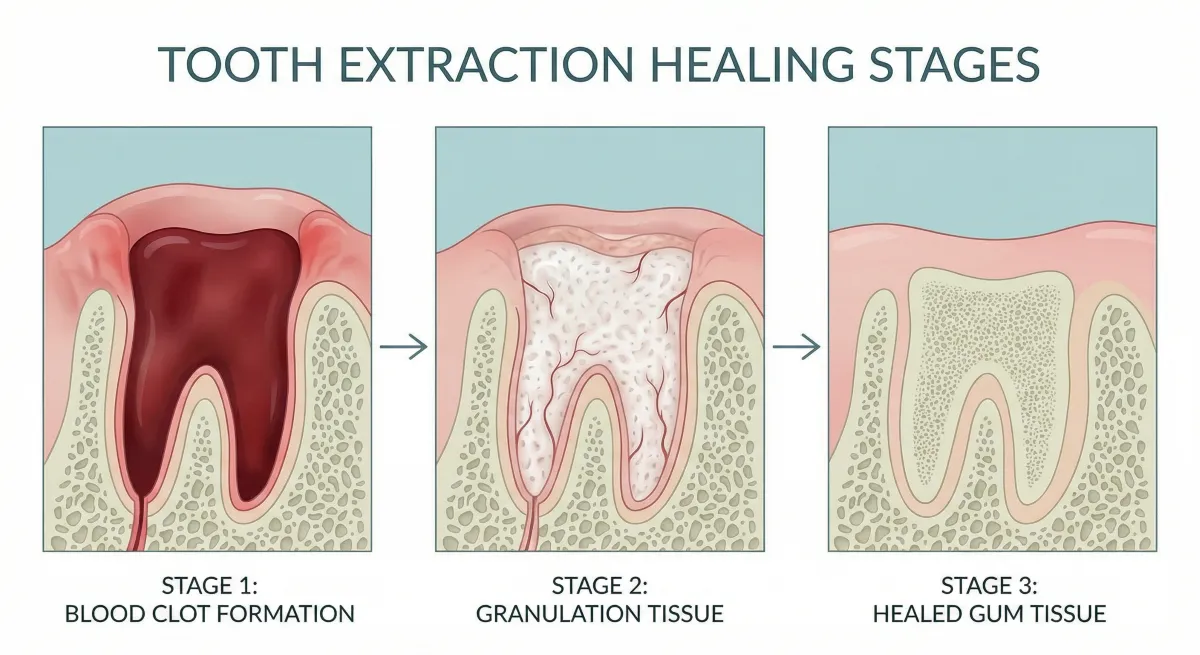
- First 24-48 Hours: Initial healing begins within 2 days. You may notice white stuff (granulation tissue) forming this is normal and part of the healing process.
- Days 2–3: Swelling and tenderness may occur temporarily and often peak around day three. Day-three discomfort is explained as part of normal healing.
- 1 to 2 Weeks: Symptoms typically improve within a few days, and full healing of the tissue may take 2 weeks.
What Does a Blood Clot Look Like After Tooth Extraction?
A healthy blood clot typically looks like a dark red or gelatinous scab forming deep within the empty tooth socket. Over the first few days, this clot may develop a white or yellowish film over it, known as granulation tissue. This is a sign of healthy cell repair and should never be picked at, brushed, or washed away.
What Are the Red Flags After Tooth Extraction?
While your tooth extraction recovery should be smooth, it is important to monitor the site. If a blood clot dislodges, you may develop a dry socket, which exposes the underlying bone.
Contact our Dental Emergency team if you experience:
-
Severe, radiating pain that worsens after day three.
-
Excessive bleeding that does not stop after applying firm pressure with gauze.
-
A fever, chills, or foul-tasting discharge from the socket.
-
Swelling that worsens significantly after the initial 72 hours.
Tooth Extraction Aftercare – Do’s and Don’ts
Following proper tooth extraction aftercare is the best way to prevent complications. Residents of Dundas and Carlisle appreciate clear aftercare instructions given on eating, rinsing, and activity before they leave the clinic.
Vital rules for a safe recovery:
-
Do apply an ice compress to the outside of your face to reduce swelling.
-
Do eat soft, cool foods for the first few days.
-
Don’t use a straw; the suction can dislodge your blood clot.
-
Don’t engage in smoking after tooth extraction. Smoking and strenuous activity are strongly discouraged during healing.
Tooth Extraction Cost in Waterdown
We believe in full transparency regarding the tooth extraction price. Costs are discussed before treatment begins so you can make an informed decision.
Factors influencing the tooth extraction cost:
- The cost varies based on the complexity of the procedure and the tooth’s location.
- Required digital imaging or the addition of nitrous oxide sedation will be factored in.
- Insurance coverage is reviewed when applicable.
- For eligible patients, we accept and review benefits under the Canadian Dental Care Plan (CDCP).
What Are the Side Effects of Tooth Extraction?
It is completely normal to experience mild physiological responses as your body heals. The tooth extraction side effects are temporary and manageable.
Normal post-operative side effects include:
- Mild to moderate soreness expected afterward.
- Swelling or tenderness that may occur temporarily.
- Mild bleeding or oozing for the first 24 hours.
- Temporary jaw stiffness from keeping your mouth open during the procedure.
What Happens After a Tooth Is Removed?
Once your extraction site has healed, leaving an empty space in your smile can cause surrounding teeth to shift. According to the Canadian Dental Association, replacing missing teeth is vital for maintaining proper bite alignment and jawbone health.
Replacement options we offer through our Family Dentistry team:
- Dental Implants: The most durable, long-lasting solution that functions like a natural tooth root.
- Same-Day Crowns & Bridges: A fixed restoration anchored to neighboring healthy teeth.
Tooth replacement options are explained when needed so you can plan your next steps.
FAQs About Tooth Extraction
What is a tooth extraction?
An extraction involves the safe removal of a tooth that cannot be saved due to severe decay, damage, or advanced gum disease. It is performed to eliminate infection and prepare the mouth for restorative treatments.
Is tooth extraction painful?
Most patients feel pressure, not pain, during the extraction. The dentist carefully applies local numbing to minimize discomfort throughout the procedure, and patient comfort is monitored constantly.
What is the tooth extraction healing time?
Initial healing begins within two days, and symptoms typically improve within a few days. Full healing of the socket and surrounding gum tissue may take up to two weeks.
Why is day 3 the worst after a tooth extraction?
The body’s natural inflammatory response peaks around 48 to 72 hours after the procedure. This day-three discomfort is explained as part of normal healing and typically subsides shortly after.
How much does a tooth extraction cost?
The cost varies based on the complexity of the procedure and the specific tooth location. We discuss all costs before treatment begins and review your insurance coverage when applicable.
What are the restrictions after a tooth extraction?
We provide clear instructions on eating, rinsing, and activity. Smoking and strenuous activity are heavily discouraged during the healing phase to prevent complications like dry socket.
Safe Tooth Removal with Clear Recovery Guidance
Delaying the removal of a severely damaged or infected tooth will only prolong your discomfort and risk your surrounding oral health. At Waterdown Smiles Dentistry, 255 Dundas St. E., Unit #17, Waterdown, ON L8B, we provide thorough clinical assessments to determine if a tooth cannot be saved. Our team is dedicated to making the dental extraction Waterdown process as stress-free as possible.
- Gentle, Precise Removal: We utilize local numbing to minimize discomfort, ensuring you feel pressure rather than pain.
- Detailed Aftercare Support: You will receive comprehensive instructions on eating, rinsing, and activity to guide your two-week healing journey.
Do not let a damaged tooth compromise your health. Schedule an evaluation today to get the relief you deserve in a comfortable, supportive environment.